
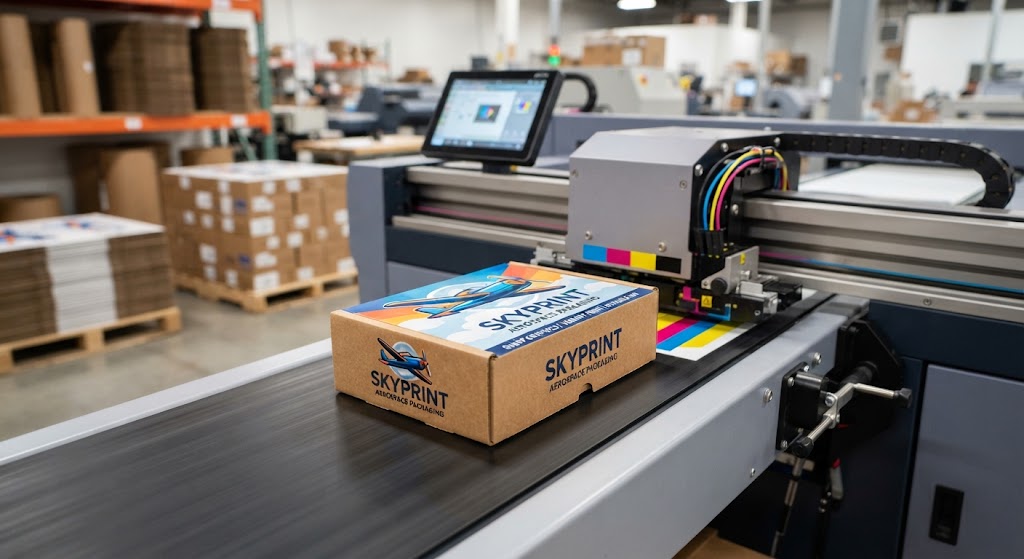
Full Color Printing On Small Aircraft Boxes: Tips For Sharp Brand Graphics
In today’s fiercely competitive e-commerce and D2C landscape, packaging has long evolved from simple logistical protection into a silent salesperson for your brand. Especially for lightweight, small-sized products (such as jewelry, cosmetics, tech accessories, and independent stationery), mailer boxes are favored for their exceptional unboxing experience and structural stability. However, achieving vibrant, sharp full-color printing on the corrugated material of small aircraft boxes is more than just transferring a flat design. This article provides an in-depth analysis of core techniques and practical insights to help your brand packaging amaze customers the moment they open it.
I. Understanding Substrate Characteristics: Corrugated Paper and Color Performance
Core Tip:Corrugated paper is not as smooth as coated art paper; its unique surface fiber texture directly affects ink absorption and diffusion.
Ink Absorbency
Sub-point : Micro-flutes like E-flute or B-flute are commonly used for small mailer boxes. While their surfaces are finer than standard shipping boxes, they still feature natural textures. Direct high-precision digital or inkjet printing can cause slight ink bleeding along paper fibers, making dot gain a crucial factor to prevent blurriness in ultra-fine lines or tiny fonts.
Liner Selection
Sub-point : To achieve the sharpest brand graphics, selecting white liner paper (such as White Kraft or CCNB) is highly recommended. White liners provide exceptional color reproduction, making full-color patterns more vibrant and high-contrast, whereas natural brown kraft paper suits vintage, minimalist, or eco-friendly styles with darker or monochromatic prints.
II. Optimizing Digital Design: Color Conversion from Screen to Physical Output
CMYK Mode & Color Calibration
Sub-point : Always set your packaging design files to CMYK mode instead of RGB. Because the physical base color of corrugated paper absorbs some light, the printed result is typically 10% to 15% darker than what appears on screen. Requesting a physical proof from the printer before mass production is strongly advised to ensure brand standard colors (Pantone/Hex) look accurate on paper.
High Resolution & Vector Graphics
Sub-point : Small mailer boxes have compact dimensions, meaning any pixelation will be magnified during close-up unboxing. All brand logos, key icons, and signature illustrations must be in vector formats (such as AI, EPS, or PDF). For embedded raster images, the resolution must remain at 300 DPI or higher to guarantee absolute sharp edges.
III. Choosing the Right Printing Technology: Digital Printing vs. Flexographic Printing
When translating exquisite design drafts into physical packaging, choosing the right printing technology route is the core determinant of visual presentation and overall cost. For small mailer boxes, mainstream industrial manufacturing currently balances between digital direct-to-object inkjet printing and flexographic printing. Digital printing, with its plate-free direct-injection characteristics, has completely revolutionized the tedious process of traditional packaging preparation.
It eliminates expensive and time-consuming plate-making steps, perfectly supporting flexible production needs for small batches, variable data printing, and multiple SKUs. Whether dealing with extremely delicate color gradients, complex full-color photographic illustrations, or customized copy tailored for different overseas markets, digital printing uses high-precision printheads to accurately anchor ink onto the micro-fluted corrugated paper fibers, delivering astonishing color saturation and dimensional depth. For D2C startups and emerging brands in their growth phase, this not only significantly reduces the financial pressure of initial stocking, but also provides infinite possibilities for rapidly iterating packaging designs, testing holiday limited editions, or conducting niche market trials.
However, when a D2C store’s business experiences explosive growth and single-order quantities reach thousands or tens of thousands of units, HD flexo printing or pre-print lamination demonstrates unparalleled scale-based cost advantages. Flexographic technology, through high-precision flexible resin plates combined with advanced anilox rollers, enables ultra-high-speed continuous mass roll-fed or die-cut paperboard printing, with a unit-cost amortization effect that is exceptionally pronounced.
Although traditional flexo was slightly inferior to digital printing when handling ultra-fine dot gradients, modern HD flexo technology combined with UV-curable or eco-friendly water-based inks can now outline brand graphics with sharp lines, high-pitched colors, and immense visual impact on white liner paper. Therefore, cross-border brand enterprises should rationally evaluate their lifecycle stage, order frequency, and budget planning: early-stage startups and multi-category testing phases should prioritize the flexibility and zero minimum order quantity (MOQ) of digital printing; whereas when blockbuster products enter a mature and stable mass-production phase, they should decisively transition to flexo to maximize profit margins.

IIII. Details Determine Success: Post-Processing Techniques for Enhanced Refinement
| Post-Processing Technique | Core Function & Visual Effect | Best Suited For |
| Matte Lamination | Applies an ultra-thin PP film to give small mailer boxes a premium, understated touch. Effectively prevents fingerprints and ink scratching while enhancing tear and moisture resistance. | Minimalist, luxury, and tech accessory brands seeking a sophisticated matte texture. |
| Gloss Lamination | Adds a glossy protective film that makes colors exceptionally vibrant, bright, and high-contrast, ensuring long-lasting graphic durability. | Vibrant, youth-oriented, or playful brands looking to maximize color pop and visual impact. |
| Spot UV Coating | Layers a high-gloss finish over specific areas (such as logos or key icons) against a matte background. Creates a stunning tactile and visual contrast (“matte + gloss”). | Premium brand identities that want critical graphic elements to stand out instantly during unboxing. |
| Hot Foil Stamping | Applies metallic foils (gold, silver, rose gold, etc.) to key text or graphics, adding a luxurious, reflective metallic texture and high-end feel. | High-end gift boxes, jewelry packaging, and special limited-edition holiday releases. |
Conclusion
For D2C e-commerce sellers, full-color printing on small aircraft boxes is not just a visual upgrade, but a crucial pivot for building brand loyalty and triggering social media virality (such as unboxing videos on TikTok and Instagram). By accurately understanding corrugated material properties, optimizing vector designs, choosing matching digital or flexographic printing methods, and utilizing post-processing surface treatments, your brand graphics can be presented to global consumers in their sharpest, most flawless form.
What is your biggest current challenge in packaging design or print execution for your D2C store? (e.g., color deviation, blurry small fonts, or cost control?)